
A practical homeowner’s guide to understanding restoration, disposal, and documentation before belongings leave the house.
In the first days after a fire, attention often turns to the structure, safety, and next steps with the insurance company. At the same time, decisions about personal property can move quickly. A contents contractor may recommend packing items for cleaning, setting aside items that appear unsalvageable, or removing damaged materials from the house. These may be reasonable steps, but they are not the same decision. Cleaning, restoring, replacing, and disposing of belongings each involve different questions. For homeowners, the goal is not to save every item or to throw everything away. It is to understand what is being proposed, what information may be lost if belongings are discarded too quickly, and how to make practical decisions that protect both the property and the claim record.
Cleaning is not the same as restoration
A clean appearance does not necessarily mean an item has been fully restored. A dining chair might look better after cleaning, but it still needs to be stable and safe to use. Clothing might look presentable but still retain odor or residue. Electronics and appliances raise another issue entirely: wiping down the exterior is not the same as confirming safe operation. When someone says an item can be restored, ask what that means in practical terms. Will the item be safe to use? Will any odor remain? Has the function been tested? Is the goal cosmetic improvement, full use, or simply temporary preservation? Those details matter because the right answer differs for a family photograph, a toaster, a laptop, or an upholstered recliner.
Different materials react differently
Fire losses often involve a mix of heat, soot, smoke residue, extinguishing water, and physical damage. Two items in the same room may not have the same outcome. Nonporous surfaces may respond well to appropriate cleaning, whereas heat-distorted plastic, swollen composite materials, or items with internal contamination may not. Upholstered furniture presents its own challenge because fabric, padding, framing, and sometimes electrical components can be affected differently. That is why homeowners should be cautious about sweeping statements such as ‘everything can be cleaned’ or ‘everything in this room is a total loss.’ Sound decisions usually depend on the specific item, the type of damage, whether the item can be restored to its intended use, and whether the overall restoration process is practical and economically sensible.
Compare the full process, not just one price
It is easy to focus on a single cleaning charge. Still, contents restoration often involves much more: pack-out, handling, inventory, transport, storage, specialty treatment, testing, repair attempts, and return delivery. Replacement also carries related costs, especially when the comparison should be to a reasonably equivalent item rather than the cheapest substitute available online. Sometimes an item is technically restorable but not economically feasible to restore. In other cases, a modestly priced keepsake may still warrant careful attention because of its personal importance. That does not automatically determine what an insurance policy will pay, but it is an important conversation to have before work begins. In other words, deciding what should happen to the property is one question; insurance valuation is another.
Document belongings before they disappear
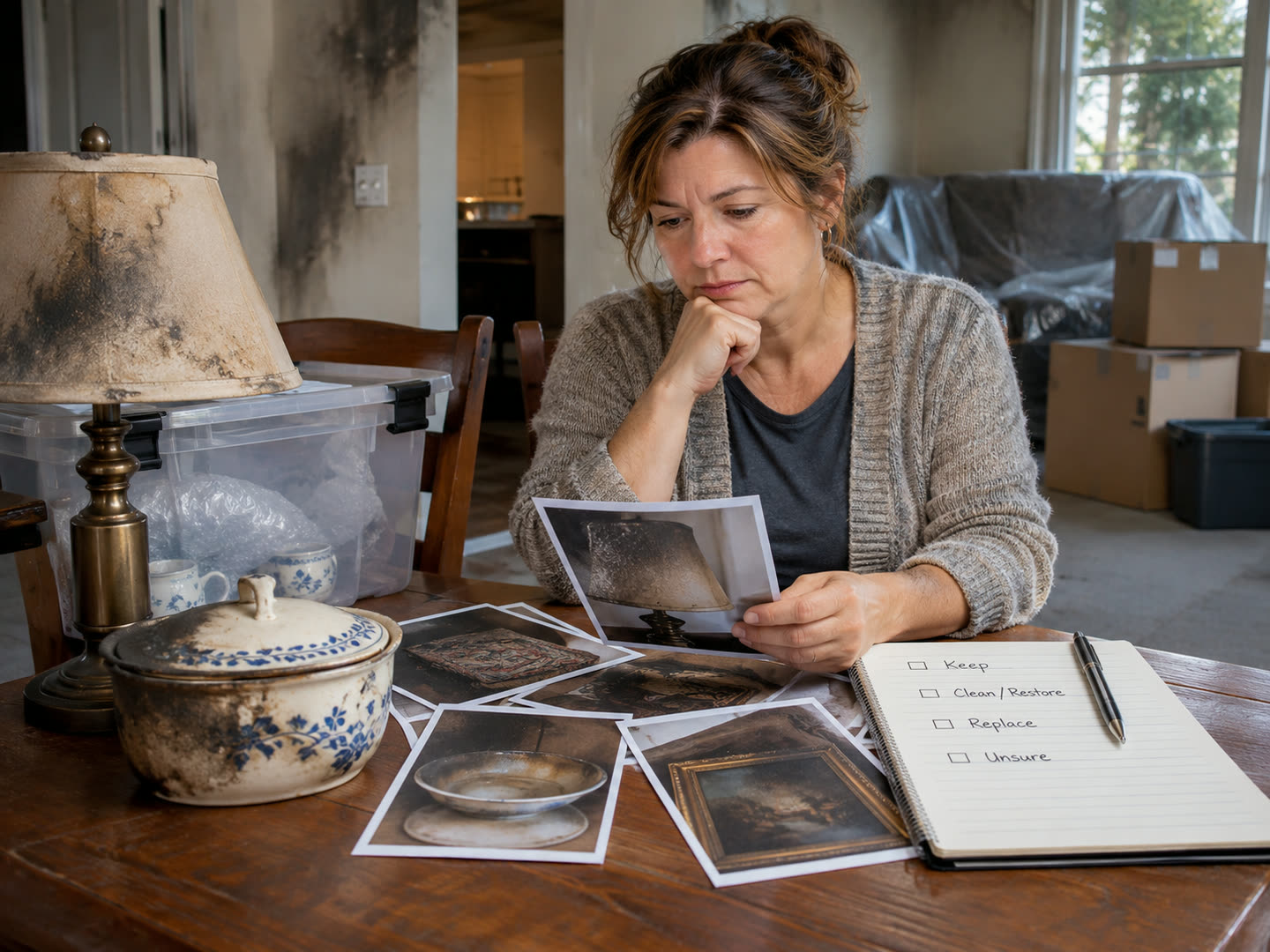
One of the biggest problems after a fire is losing the record of what was there. Before belongings are packed out or discarded, photograph the room as found, then take additional photos of notable or higher-value items when it is safe to do so. For items likely to matter later, record the room location, a short description, the brand or model if available, and the visible condition. If you already have pre-loss home inventory photos, save copies where you can access them easily. Request a written list detailing what is being removed from the home, where it is going, and how it is categorized. If the proposal separates items into restore, evaluate, or dispose, it should state that clearly in writing. Save photographs, estimates, authorization forms, storage terms, and any contractor communications. A recommendation to replace an item is not permission to discard it, and a recommendation to dispose of property should not precede the documentation needed to understand what is being lost.
Questions worth asking before authorizing contents work
- Will items be evaluated individually, or will broad categories make the recommendation?
- Are test cleanings or specialist reviews appropriate for uncertain, unusual, or high-value property?
- What services are included in the quoted cost, and what charges could be added later?
- How will belongings be tracked during pack-out, storage, and return?
- What happens if an attempted restoration is unsuccessful?
- Which items are recommended for disposal now, and what documentation supports that decision?
- Will the homeowner receive a copy of the inventory, photographs, and final disposition records?
Know where safety changes the analysis
Not every item should remain in the home while documentation questions are resolved. When property poses a legitimate safety or health concern, qualified safety instructions take precedence. Fire-damaged electrical items, contaminated soft goods, and unstable materials may require special handling. The point is not to keep dangerous property around merely to improve a claim file. The point is to document what can be documented safely, make informed decisions, and avoid unnecessary loss of information. If urgent disposal is required, document the process as conditions allow. A few organized photographs and written notes can make a significant difference later.
The bottom line
After a fire, homeowners do not need to become restoration experts overnight. They do, however, need to slow the process enough to understand what is being proposed. Ask what can reasonably be restored, what cannot, what still needs evaluation, and what records you will receive before the property leaves the house. Good documentation and a little organization can help preserve options, support the insurance claim, and reduce the risk that important belongings vanish into a process you never fully understand.
Sources and further reading
Annissa Coy, “Can We Save It? What Restorers Need to Know About Contents Restoration,” Restoration & Remediation, November 5, 2026.
Related guides: first steps after a loss, photograph your home, and check professional credentials.